JOURNAL / AI SEARCH & PUBLISHING

AI search visibility,
without the hacks.

A site owner’s guide to crawl access, useful pages, citations, and the traffic that follows.

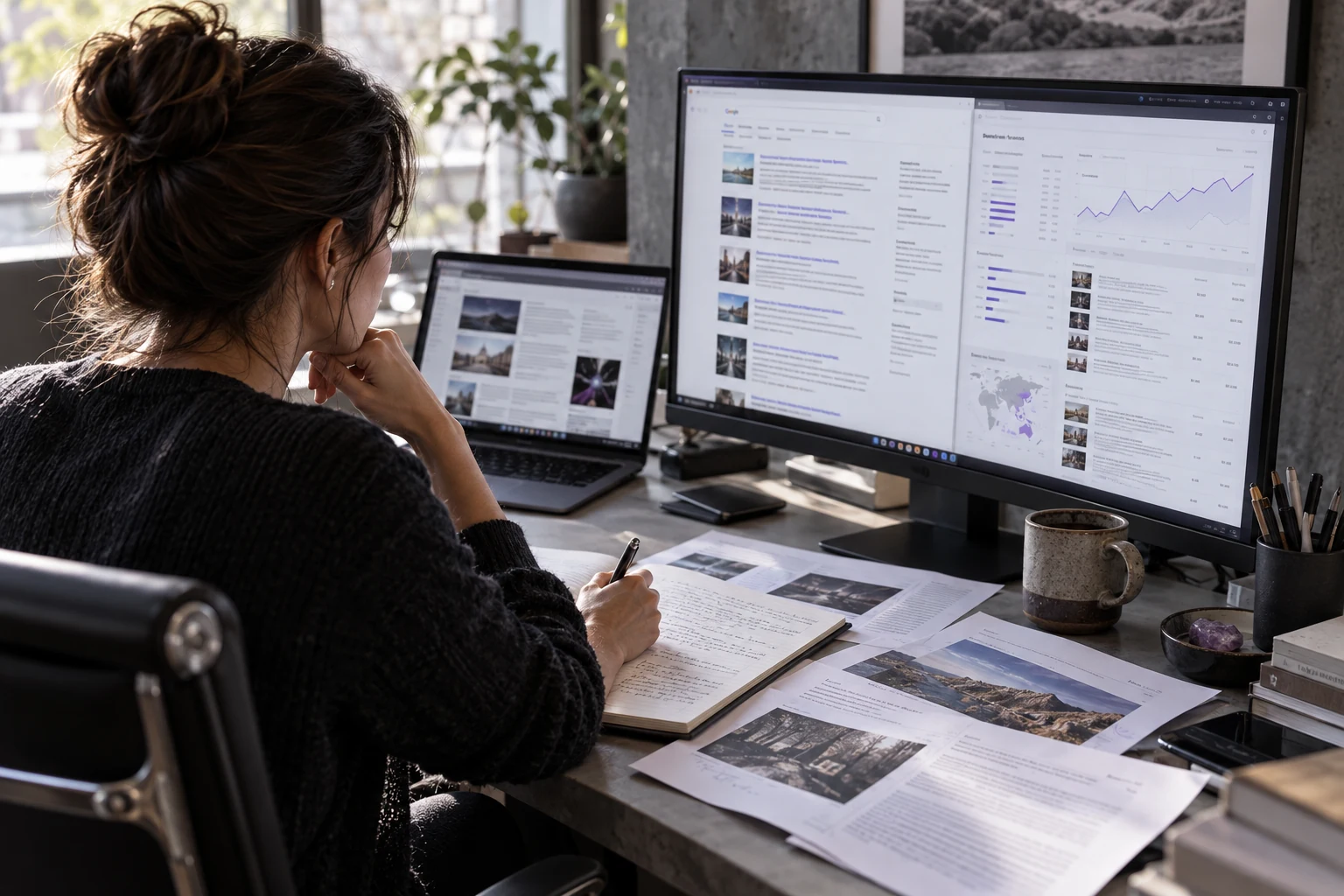
A website publisher reviews search results and analytics beside printed page proofs.PUBLISHING / MEASUREMENT / SYMPLOKA
A CITATION IS A SIGNAL

Visibility is not the same as a visit.

A page can appear as a source and still send no visitor. Measure the appearance, the click, and the useful action separately.

01 / APPEARANCE, VISIT, OUTCOME

Three different events need three different measures.

AI search can show a page as a source, a person can choose to open it, and that visit may or may not lead to a useful result. Each step answers a different question. A citation count is not a traffic report; a referral visit is not a conversion; and neither one, by itself, explains what someone understood or decided.

VisibilityDid a page appear in a search surface or get cited in a generated answer? Use the report that covers that surface.
ReferralDid someone follow a link to the site? Measure sessions and landing pages in your analytics, with source labels where available.
OutcomeDid the visit lead to the action the site is designed for, such as a sign-up, enquiry, or sale? Define that event separately.

Keep the words precise. “The page was cited” describes a source appearance. “The page brought a visit” describes a click through. “The page performed” should name the result you actually measured.

02 / ACCESS & USEFULNESS

Make the page accessible. Give it a reason to be chosen.

For Google Search, the foundation is still ordinary SEO: a page must be accessible to Google and eligible to appear in Search. Google’s current guidance emphasizes original, useful material, clear organization, relevant media, crawl access, and a good experience across devices. It treats AI Overviews and AI Mode as part of Search rather than a separate publishing system.

That means you do not need to add an AI-only schema, create an llms.txt file for Google, split every article into tiny blocks, or publish a page for every phrasing of the same question. Google says those tactics are not special requirements for its generative Search features. Write the page that best serves the real question, with a clear point of view and evidence a reader can follow.

ChatGPT Search has its own access control. OpenAI says a publisher should allow OAI-SearchBot and its published IP ranges for a site to be eligible for search results; placement is not guaranteed. OAI-SearchBot and GPTBot are separate controls: the first concerns search visibility, while the second concerns use of crawled content for model training. Choose each setting deliberately.

Technical access can make a page eligible. No file, schema, phrase, or prompt formula can guarantee that an AI system will cite it.

For more on how summaries find and combine sources, continue to how AI search works ↗.

03 / METRICS WITH A DEFINED SCOPE

Use each report for what it actually measures.

As of October 2026, Google Search Console has a dedicated Generative AI performance report for eligible Search and Discover features. Google says it reports impressions, pages, countries, devices for Search, and performance over time. Those measures show where pages appeared within Google’s AI features; compare them with ordinary Search data and your own referral and outcome reports.

Google Search ConsoleGenerative AI impressions and URLs, with country, device, and date views. Google says the report is available worldwide.
Bing Webmaster ToolsAI Performance reports citations, cited pages, grounding-query phrases, and trends across supported experiences. Query phrases are sampled, and citations do not mean ranking or placement.
Site analyticsReferral sessions, landing pages, and the actions you define. This measures visits that reached your site, not answers that appeared without a click.
Repeatable spot checksRecord a small set of real questions, location, language, date, and product. Save the answer and source links; treat a few manual checks as examples, not a market-wide score.

Bing’s Topics Portfolio, introduced as a beta in October 2026, groups observed grounding queries into topic clusters and surfaces possible query opportunities. Bing says the topic classification and ecosystem estimates are approximate. Use it to decide what to inspect, not as a precise ledger or a promise of future traffic.

One useful distinction: analytics can show referrals tagged from an AI service, but a citation dashboard can show source appearances that never became visits. Keep both views, and do not add their counts together.

04 / FOUR WEEKS OF PRACTICAL WORK

Improve the pages people need. Then watch what changes.

  1. Week 1 — Establish a baseline. Verify the site in Search Console and Bing Webmaster Tools. Review indexing, sitemap delivery, server errors, internal links, analytics sources, and the pages that already earn search impressions or visits. Check crawler rules on the site, CDN, and firewall.
  2. Week 2 — Strengthen a few useful pages. Choose pages that answer questions your audience actually has. Make the main answer easy to find, add first-hand detail or a clear method, link important claims to primary evidence, and show dates where freshness matters.
  3. Week 3 — Connect the site. Add internal links from relevant pages, make product and company names consistent, and ensure structured data matches visible content. Use images when they explain or document the page; do not add decorative assets or boilerplate just to look optimized for AI.
  4. Week 4 — Review by surface. Compare Google’s AI impressions, Bing’s citation and query signals, referral sessions, and the outcomes that matter. Note seasonality, campaigns, and major page changes. Keep a longer trend before drawing a conclusion from a small movement.

A 2025 Pew Research Center analysis offers a useful caution about traffic: it observed 900 U.S. adults using Google in March 2025. People clicked an ordinary result on 8% of visits with an AI summary, versus 15% without one; links inside summaries were clicked on about 1% of those visits. This is one historical, observational sample of Google use—not a forecast for every site, country, AI product, or current search page.

The goal is not to win a screenshot. It is to make your best information findable, understandable, and worth opening—and to know which of those things you have actually observed.

Continue with how to read a benchmark ↗ and the AI field guide ↗.

SOURCES & FURTHER READINGGoogle Search Central, optimizing for generative AI features ↗Google Search Central, AI features and your website ↗Google Search Central, Search Console Generative AI performance reports ↗Microsoft Bing, AI Performance in Bing Webmaster Tools ↗Microsoft Bing, Topics Portfolio beta ↗OpenAI, overview of web crawlers ↗Pew Research Center, observed clicks on Google AI summaries ↗

Explore more ideas and practical guides ↗