JOURNAL / IMAGE GENERATION

How do AI image generators work?
From a prompt to an image.

A text-to-image model turns a written description into a visual result. Many familiar systems use diffusion: a model learns to remove noise, then applies that skill in a sequence shaped by the prompt.

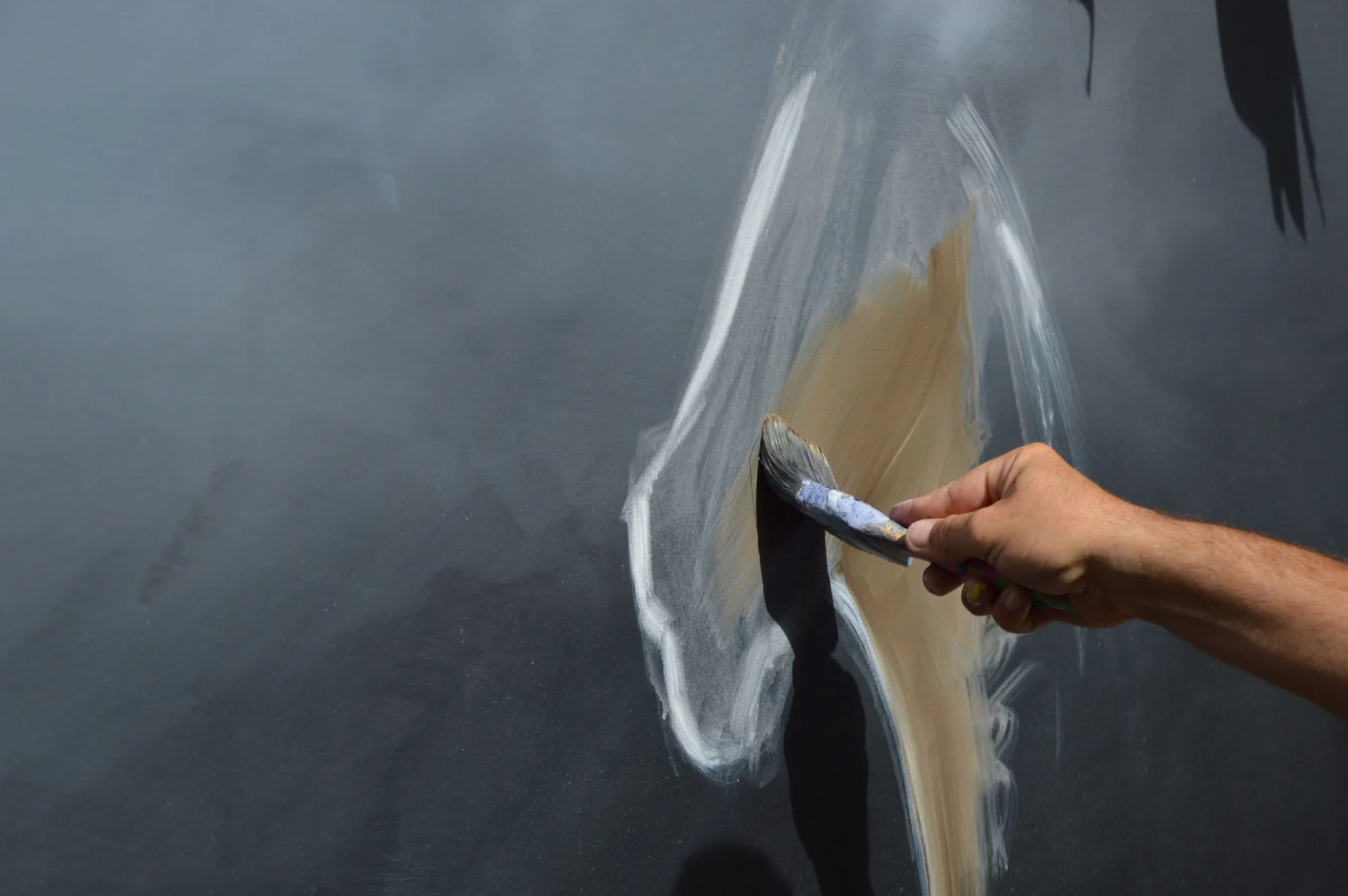
An artist paints a broad, expressive brushstroke across a canvas.IMAGE / GENERATION / SYMPLOKA
A DESCRIPTION BECOMES A VISUAL FIELD

The prompt steers the process. It does not specify every pixel.

A generative model builds an image through learned visual relationships. The output can be evocative and useful while still missing a count, label, or detail the brief made explicit.

01 / THE SHORT VERSION

Diffusion learns a route from noise to structure.

During training, a diffusion model sees images at different noise levels. A standard approach gradually adds noise to an image and trains a neural network to estimate the denoising step. Across many examples, the model learns visual patterns that help it move from a noisy representation toward coherent shapes, textures, and scenes.

At generation time, the process starts from a random noisy representation. The trained model applies a sequence of denoising steps. A text condition can influence those steps, so the result tends toward visual patterns associated with the description. The original diffusion paper describes this as a learned reverse process; it is a useful mental model, not a claim that every image model works this way.

In the usual diffusion generation loop, the model repeatedly transforms noise according to learned parameters; it does not search a reference library and assemble a collage. Models can still memorize or reproduce aspects of training examples, so this mechanism alone says nothing about copyright, attribution, or permitted use. Those questions depend on the particular model, evidence about its training, and applicable terms and law.

02 / WHY WORK IN LATENT SPACE?

Many systems denoise a compressed representation first.

Operating on every image pixel at high resolution can be expensive. Latent diffusion models first encode an image into a smaller learned representation, perform the diffusion steps there, then decode the result back into pixels. This can reduce computation while preserving useful visual detail.

The compressed space is called latent space. It is a model’s internal representation, not a neat miniature picture where each coordinate has an obvious human meaning. A decoder translates the final representation into the image you see.

Some latent diffusion architectures use cross-attention to connect text features with visual generation. In everyday terms, this gives the process a way to draw on the prompt while producing the image. It is guidance, not a precise scene plan: spatial relationships, small text, exact numbers of objects, and fine details can still come out differently from the request.

03 / WHAT THE PROMPT CONTROLS

A prompt is direction, not a pixel-by-pixel contract.

With text-conditioned diffusion, an encoder represents the prompt in a form the image model can use during denoising. A prompt describing a red bicycle beside a glass building encourages those concepts to appear together. The model still has to infer what “beside” means in this composition, how large each object should be, and which details matter most.

Useful prompts state the subject, action, setting, composition, and visual treatment. If the image must include exact words, a fixed number of objects, a correct diagram, or a faithful product, treat those as requirements to inspect after generation. A polished picture is not proof that the contents are accurate.

  1. Name the subject and action. Say what is present and what is happening.
  2. Describe the frame. Give the setting, viewpoint, distance, and relative placement of important elements.
  3. Choose a visual direction. Describe light, texture, palette, or medium in concrete terms.
  4. State the must-haves. Separate required details from atmosphere and optional flourishes.
  5. Inspect the result. Regenerate or edit specific problems; check factual claims against independent evidence.

For a broader guide to prompts as briefs, read how to write a clearer prompt ↗.

04 / DIFFUSION IS NOT THE ONLY DESIGN

Image generation has more than one architecture.

Some systems represent images as sequences of tokens and generate those tokens autoregressively, using a process related to next-token prediction in language models. Chameleon is a research example of an early-fusion model trained to understand and generate text and images in mixed sequences.

So “AI image generator” describes a capability, not one universal recipe. The architecture, training data, conditioning method, safety controls, and editing tools vary by model. When choosing a system, check its documentation, license, privacy terms, and performance on the task you actually need.

To compare output with source evidence, continue to how to check an image’s origin and context ↗. To understand the text side of the system, see how language models generate text ↗.

05 / WHAT TO CHECK BEFORE YOU USE ONE

Judge the whole workflow, not just the preview.

  • Task fit. Can it produce the composition, format, and level of control your work requires?
  • Repeatability. Can you record the model version, prompt, settings, and edit history needed to reproduce or explain a result?
  • Rights and terms. Check the model provider’s training, output, and commercial-use terms for your situation.
  • Privacy. Understand whether prompts and uploaded reference images are sent to a service, retained, or used under its published terms.
  • Evidence. Do not use visual realism as proof. Verify factual scenes, people, products, and labels independently.

The right tool depends on the job and the costs of getting it wrong. Start with a task-based model comparison ↗ and the AI field guide ↗.

Before publishing a generated image, check service terms and human contribution separately. Read the guide to AI authorship and copyright ↗.

PAPERS & REFERENCE IMPLEMENTATIONHo, Jain & Abbeel, Denoising Diffusion Probabilistic Models (2020) ↗Rombach et al., High-Resolution Image Synthesis with Latent Diffusion Models (CVPR 2022) ↗Chameleon Team, Mixed-Modal Early-Fusion Foundation Models (2024; revised 2025) ↗CompVis / latent-diffusion research code ↗