JOURNAL / MODEL ARCHITECTURES

Mixture of Experts.
One model. Selective routing.

A Mixture-of-Experts model contains multiple neural sub-networks and a learned router that selects a subset for each input or token. It can grow a model’s total capacity without activating every expert on every step.

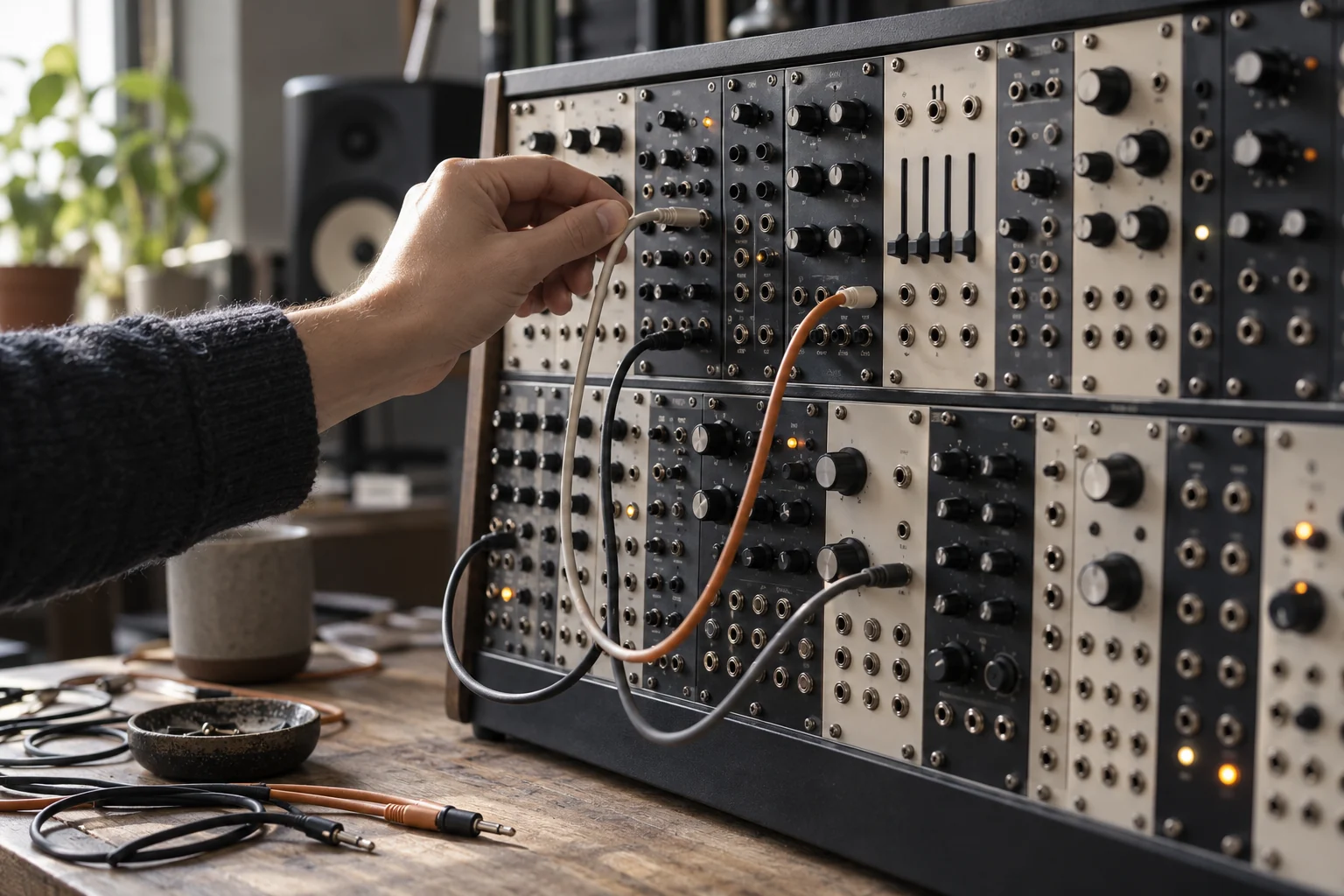
A hand connects selected patch cables on an analog modular synthesizer with many available modules.ARCHITECTURE / ROUTING / SYMPLOKA
CAPACITY WITH A SELECTIVE PATH

More components. A narrower route.

A mixture-of-experts layer uses a router to direct each token through selected neural sub-networks. The instrument is only a visual analogy: model experts are learned computations, not human specialists.

01 / MANY EXPERTS INSIDE ONE MODEL

“Expert” means a trained sub-network, not a little specialist agent.

A Mixture of Experts (MoE) is a neural-network design that combines a set of expert sub-networks with a gating network or router. In many Transformer language models, an MoE layer uses feed-forward networks as its experts. They are trained as parts of the larger model, not launched as separate chatbots that each receive the whole question.

In a sparse MoE, the router uses a token’s current representation to choose one or more experts. Those experts process that token, and the model combines their outputs before continuing. Another token in the same prompt may be routed differently.

Token representationThe information about the current token and its context at this layer.
RouterA learned component that assigns scores and selects experts for that token.
Selected expertsThe feed-forward sub-networks activated for this step.
Combined outputThe selected experts’ results are weighted or combined and passed onward.

The name can suggest clean human-readable specialties, such as a “math expert” and a “poetry expert.” The architecture does not promise that kind of division. Experts learn useful internal patterns through training; interpreting those patterns takes separate evidence.

02 / DENSE VS. SPARSE COMPUTATION

A sparse model does not run every expert for every token.

Dense feed-forward layerThe same feed-forward weights process every token at that layer.
Sparse MoE layerA router chooses a small number of experts from a larger pool for each token.

This is a form of conditional computation: the model has a larger pool of parameters available, while each token uses only a selected portion of the expert computation. The original sparsely-gated MoE paper describes a trainable gating network choosing a sparse combination of experts for each input.

Architectures make different routing choices. The Switch Transformer uses a simplified top-one route: each token goes to one expert in an MoE layer. Mixtral 8x7B chooses two of eight feed-forward experts for each token at each MoE layer. “MoE” describes a family of designs, not one universal routing algorithm.

03 / TOTAL PARAMETERS & ACTIVE PARAMETERS

Active parameters tell you about a token’s path, not the whole machine.

For an MoE model, the total parameter count includes the expert weights that belong to the model. The active-parameter count estimates the parameters used to process one token along its selected route, including the relevant shared parts. The two numbers describe different things.

Mixtral’s 8x7B report gives a clear example: about 47 billion parameters in total, with about 13 billion active for each token during inference. Different tokens can select different pairs of experts. Those numbers describe that specific architecture and should not be applied to other MoE models.

“13B active” does not mean the system can necessarily run from memory sized for a dense 13B model. The expert weights still need to be available wherever the runtime places them.

Actual memory and latency depend on precision, cache, batching, hardware, how experts are distributed, and the serving software. For a device-level comparison, see how small models fit a deployment budget ↗ and what happens during AI inference ↗.

04 / WHY ROUTING IS A TRADE-OFF

Sparse computation can shift the bottleneck.

MoE can add model capacity while limiting the expert computation applied to each token. But choosing and dispatching experts adds work. Distributed models may need communication between devices to reach the selected experts; poor routing balance can leave some experts overloaded while others do little work.

CapacityA larger pool of learned parameters can be available to the model.
Per-token computeSparse top-k routing avoids running every expert for every token.
MemoryInactive expert weights may still need to be stored, loaded, or distributed.
CommunicationMoving token data to experts can add latency and constrain scaling.

Training also has to keep routing workable. Switch Transformer research discusses balancing expert use, routing instability, and communication cost. In practice, a model with fewer active parameters is not automatically faster or cheaper for every device, batch size, or request pattern. Measure the deployed runtime.

05 / COMMON QUESTIONS

Four quick distinctions.

Is MoE an ensemble?Not in the usual sense. MoE experts are components of one jointly trained model, selected by its router.
Does one expert handle the whole prompt?Not necessarily. Routing can happen token by token, so different positions can take different paths.
Are experts human-style specialists?No. They are learned neural sub-networks; a skill label needs evidence beyond the name.
Does a low active count guarantee lower memory?No. Active computation and the memory needed to serve expert weights are separate measurements.

MoE is one architectural way to balance model capacity and computation. If you are comparing model families, also see how large language models generate text ↗ and how quantization changes model weights ↗.

FOUNDATIONAL & MODEL PAPERSShazeer et al., “Outrageously Large Neural Networks: The Sparsely-Gated Mixture-of-Experts Layer” ↗Fedus, Zoph & Shazeer, “Switch Transformers: Scaling to Trillion Parameter Models with Simple and Efficient Sparsity” ↗Jiang et al., “Mixtral of Experts” ↗

Fit a model to a device and task ↗
See how Transformer layers process tokens ↗
Explore efficient intelligence research at Symploka ↗