JOURNAL / AI & SCIENCE

AI for science.
Make the next test matter.

AI can forecast a system, infer a structure, or search millions of candidates. The discovery begins when a prediction meets a measurement that could prove it wrong.

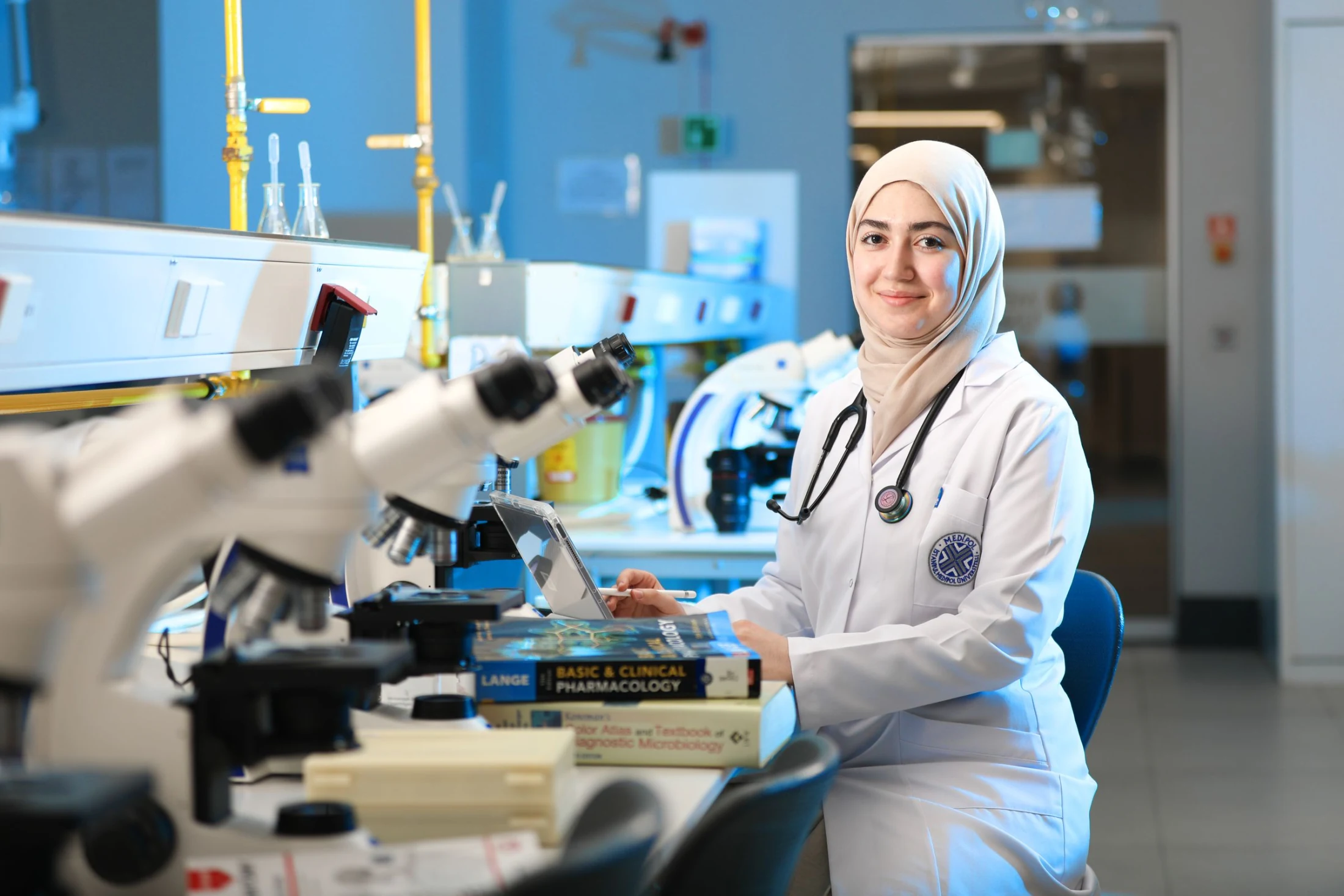
A scientist works beside a microscope in a bright research laboratory.SCIENCE / MODEL / MEASUREMENT / SYMPLOKA
A PREDICTION IS A PLACE TO BEGIN

The experiment still gets the final word.

Models can narrow a search or point to a pattern. A result becomes useful knowledge when a well-designed test can reproduce it.

01 / THREE DIFFERENT JOBS

“AI for science” is a family of methods, not one machine scientist.

Scientific systems use machine learning in very different ways. One may estimate the probability of tomorrow’s weather; another may infer the shape of a molecular complex; a third may rank materials worth trying to synthesize. Each output answers a different question and needs a different kind of test.

ForecastEstimate a distribution of possible future states, then check calibration and accuracy against observations.
InferEstimate an unobserved structure or property from measured inputs, then compare it with independent measurements.
SearchGenerate or rank candidates under a model, then test whether they can exist, be made, and perform the intended function.
ExplainPropose a mechanism or relationship. It remains a hypothesis until a test distinguishes it from plausible alternatives.

These tasks can reinforce each other, but their scores are not interchangeable. A good benchmark forecast is not a new biological mechanism; a plausible molecule is not a working medicine; a generated candidate is not a laboratory result.

02 / THREE RESEARCH EXAMPLES

What the headline results actually measure.

GenCast: a probabilistic forecast

GenCast produces ensembles of global weather forecasts up to 15 days ahead. In the Nature evaluation, its continuous ranked probability score (CRPS) was better than ECMWF ENS on 98.1% of 5,400 targets in a mean pooled comparison, and 97.6% in a maximum-pooled comparison. Those percentages count scored targets, not forecasts that were “correct.” The result comes from a defined retrospective scorecard, not every location or extreme event. For the model, operational context, and evaluation limits, read our guide to AI weather forecasts ↗.

The important design choice is probability: an ensemble represents multiple plausible futures rather than presenting one trajectory as certain. For decisions about flooding, energy, or travel, that distribution has to be calibrated and useful at the place and time of the decision.

AlphaFold 3: a predicted molecular arrangement

AlphaFold 3 predicts joint structures for complexes that can include proteins, DNA, RNA, small molecules, ions, and modified residues. The authors report higher accuracy than many specialized methods across their evaluated categories. This makes structural hypotheses easier to generate; it does not show by itself that a predicted molecule binds in a living cell, changes a biological process, or works as a treatment.

Those are separate claims. They require experiments designed for the interaction and biological context at issue, with controls that can expose an attractive but incorrect structural model.

GNoME: a search over possible materials

Google DeepMind’s GNoME uses graph neural networks and iterative density-functional-theory calculations to search for inorganic crystal structures. The paper reports 2.2 million structures predicted stable relative to the Materials Project reference and 381,000 entries on the updated convex hull. It also reports 736 structures with independent experimental verification.

Those numbers describe different levels of evidence. The 381,000 are not 381,000 materials made in a lab. The authors identify synthesizability, dynamic stability, and phase behavior as continuing challenges. A computationally stable candidate is a shortlist for researchers, not a finished material with proven usefulness.
03 / FROM OUTPUT TO EVIDENCE

Let the test be stronger than the prediction.

A model can make a search faster and suggest experiments a person might not have tried. It can also learn patterns that do not hold in the next dataset, laboratory, season, or population. Good science makes that boundary visible instead of hiding it behind a polished output.

  1. State the claim precisely. Name the quantity or outcome, the conditions, and what observation would count against the prediction.
  2. Keep a fair comparison. Compare against a strong, relevant baseline using the same data, conditions, and evaluation rules.
  3. Protect the test data. Check for overlap, leakage, and repeated measurements. Reserve independent examples—or a separate site or time period—for the final test.
  4. Report uncertainty and failures. Show where confidence is calibrated, which cases fail, and how performance changes outside the average case.
  5. Confirm the kind of claim you make. A structure claim needs structural evidence; a forecast needs observed outcomes; a materials candidate needs synthesis and characterization; a biological effect needs a relevant assay.
  6. Make the result reproducible. Record data versions, model and code versions, protocols, exclusions, and analysis choices so another group can challenge or repeat the result.

The goal is not to make the scientist smaller. It is to spend attention where judgment matters: choosing the question, designing a discriminating test, noticing an unexpected result, and deciding what the evidence supports.

04 / THE REAL BOTTLENECK

When prediction gets cheap, trustworthy measurement gets more valuable.

AI can generate more forecasts, structures, or candidate materials than a lab can test. That shifts the bottleneck: the limiting resource becomes high-quality data, experimental capacity, domain expertise, and clear decisions about which result is worth following.

That makes the full research loop the right unit of progress: question → model → candidate → experiment → observation → revised question. A faster model matters when it improves this loop—by finding a useful result sooner, reducing wasted work, or revealing a pattern that survives an independent test.

A striking output can start the conversation. A careful measurement is what lets the next person trust it.

PRIMARY RESEARCHPrice et al., Probabilistic weather forecasting with machine learning, Nature (2025) ↗Abramson et al., Accurate structure prediction of biomolecular interactions with AlphaFold 3, Nature (2024) ↗Merchant et al., Scaling deep learning for materials discovery, Nature (2023) ↗