JOURNAL / VISION, LANGUAGE & ACTION

What are vision-language-action models?
When language becomes action.

A VLA model connects visual observations and instructions to actions a robot can carry out. The hard question is what happens after the model proposes a move: whether it is safe, whether the robot can perform it, and whether the intended physical change actually took place.

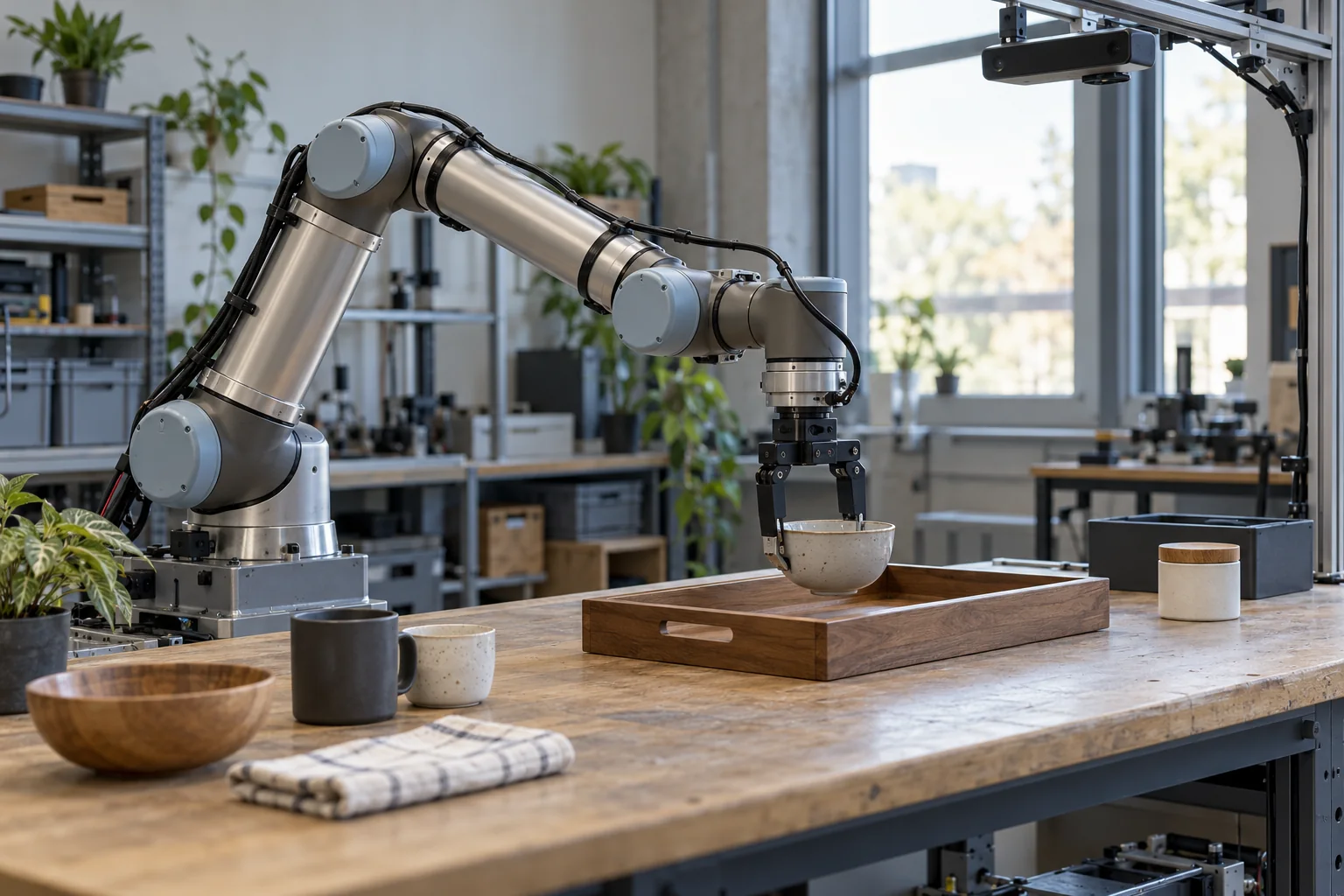
A six-axis robot arm carefully placing a ceramic bowl into a wooden tray on a workbench.VLA MODELS / ROBOT CONTROL / SYMPLOKA
OBSERVE, ACT, CHECK AGAIN

A robot has to ground language in a changing scene.

A command becomes useful only when perception, action, hardware, and feedback stay connected through the task.

01 / FROM WHAT THE ROBOT SEES TO WHAT IT DOES

A VLA model predicts a robot action from language and observation.

A vision-language model can answer a question about an image or connect words to visual objects. A vision-language-action (VLA) model adds an output designed for robot control. It may receive a camera image, an instruction such as “place the bowl in the tray,” and additional state from the robot. It then predicts an action representation for the controller.

The model does not directly move a motor by understanding English. A robot system still needs software to interpret the output, apply control limits, communicate with hardware, and read sensors after the movement.

02 / CONNECT GENERAL KNOWLEDGE TO DEMONSTRATIONS

Pretraining helps with concepts; robot data teaches control.

Research VLA systems commonly combine a pretrained vision-language model with demonstrations of robot behavior. The pretrained model supplies visual and language features; robot data shows how observations and instructions correspond to movements on particular hardware.

Google DeepMind’s RT-2 represented robot actions as tokens and jointly fine-tuned vision-language models on web data and robot trajectories. OpenVLA studied another open research direction: adapting pretrained vision-language models using diverse real-robot demonstrations. Both papers investigate whether broader visual and language knowledge can help a learned policy follow instructions and act in new situations.

Those are results from particular architectures, training data, and tests. A model’s broad image knowledge does not automatically teach it the reach, force, timing, or recovery behavior needed for a physical task.

03 / HOW ACTIONS ARE REPRESENTED

“Move the gripper” can become different kinds of model output.

One model may encode action values as discrete tokens in a sequence. Another may predict continuous quantities such as position changes and gripper state. A system can also predict a short chunk of several actions together, then hand that segment to a controller.

These choices affect how a model is trained and how often it needs to make a new prediction. OpenVLA-OFT studies fine-tuning choices including continuous action representations, action chunking, and parallel decoding. Its benchmark results belong to the policies and evaluation setup described in that paper; they are not a universal speed or success guarantee.

The robot’s controller turns the chosen representation into timed commands for specific actuators. It must still respect the machine’s workspace, speed, force, joint limits, and stop behavior.

04 / LEARNING ACROSS TASKS AND ROBOTS

More data can broaden experience, but bodies are not interchangeable.

A training set can combine demonstrations from different tasks, environments, and robot designs. This may expose useful common patterns, but each platform still has its own cameras, gripper, reachable space, movement scale, and timing.

The π0.5 paper describes co-training on heterogeneous sources, including data from multiple robots, semantic subtask predictions, web examples, and low-level actions. The authors report tasks in previously unseen homes. That is evidence about their tested system and conditions—not proof that a VLA can operate safely in any house or transfer to any robot without adaptation.

When a team changes hardware, it should test that embodiment directly. A new gripper, camera position, or controller can change how the same predicted action behaves in the world.

05 / CLOSE THE LOOP

An action prediction is not proof that the task is complete.

A practical control loop observes the scene, predicts a bounded action, executes it, and checks new sensor data before continuing. If an object slips or the scene changes, the next decision needs the updated evidence. Running a long sequence without checking progress can let a small error grow into a larger one.

ObserveCapture current camera, robot-state, and contact signals relevant to the task.
PredictGenerate an action or short action segment grounded in the instruction and current state.
ConstrainUse the controller and safety system to enforce operating limits before movement.
VerifyCheck whether the physical state changed as intended; recover, stop, or request help when it did not.

A VLA can be one part of this loop. Planning, force control, collision checking, emergency stops, and human supervision may belong to other components of the system.

06 / EVALUATE THE ROBOT, NOT THE SENTENCE

Language following matters only when the physical result is right.

A robot can select an object matching the instruction and still drop it, place it incorrectly, or fail to finish. Evaluate the full task on the target hardware and define what physical state counts as success.

  1. Test the instruction. Does the robot act on the intended object and destination?
  2. Vary the scene. Move objects, change lighting and camera views, and include occlusion or clutter.
  3. Check control quality. Record task completion, cycle time, retries, and operator interventions.
  4. Test recovery. Interrupt an action, introduce a failed grasp, and verify that the system detects the changed state.
  5. Exercise safety limits. Confirm bounded speed and force, a reliable stop, and safe behavior when the observation is uncertain.

Simulation can expand early testing, but it does not replace controlled evaluation on the real robot. For the broader system view, read how physical AI connects sensors, models, and motion ↗ and how to evaluate a complete AI agent ↗.

PRIMARY RESEARCHBrohan et al., RT-2: Vision-Language-Action Models Transfer Web Knowledge to Robotic Control (2023) ↗Kim et al., OpenVLA: An Open-Source Vision-Language-Action Model (2024) ↗Kim, Finn & Liang, Fine-Tuning Vision-Language-Action Models: Optimizing Speed and Success (2025) ↗Physical Intelligence et al., π0.5: a Vision-Language-Action Model with Open-World Generalization (2025) ↗