JOURNAL / DEEP LEARNING

What is deep learning?
Many layers. One learning process.

Deep learning is a family of machine-learning methods that use models with multiple layers to learn representations from data. The depth describes the model’s structure; it does not tell you whether the result is accurate, safe, or useful.

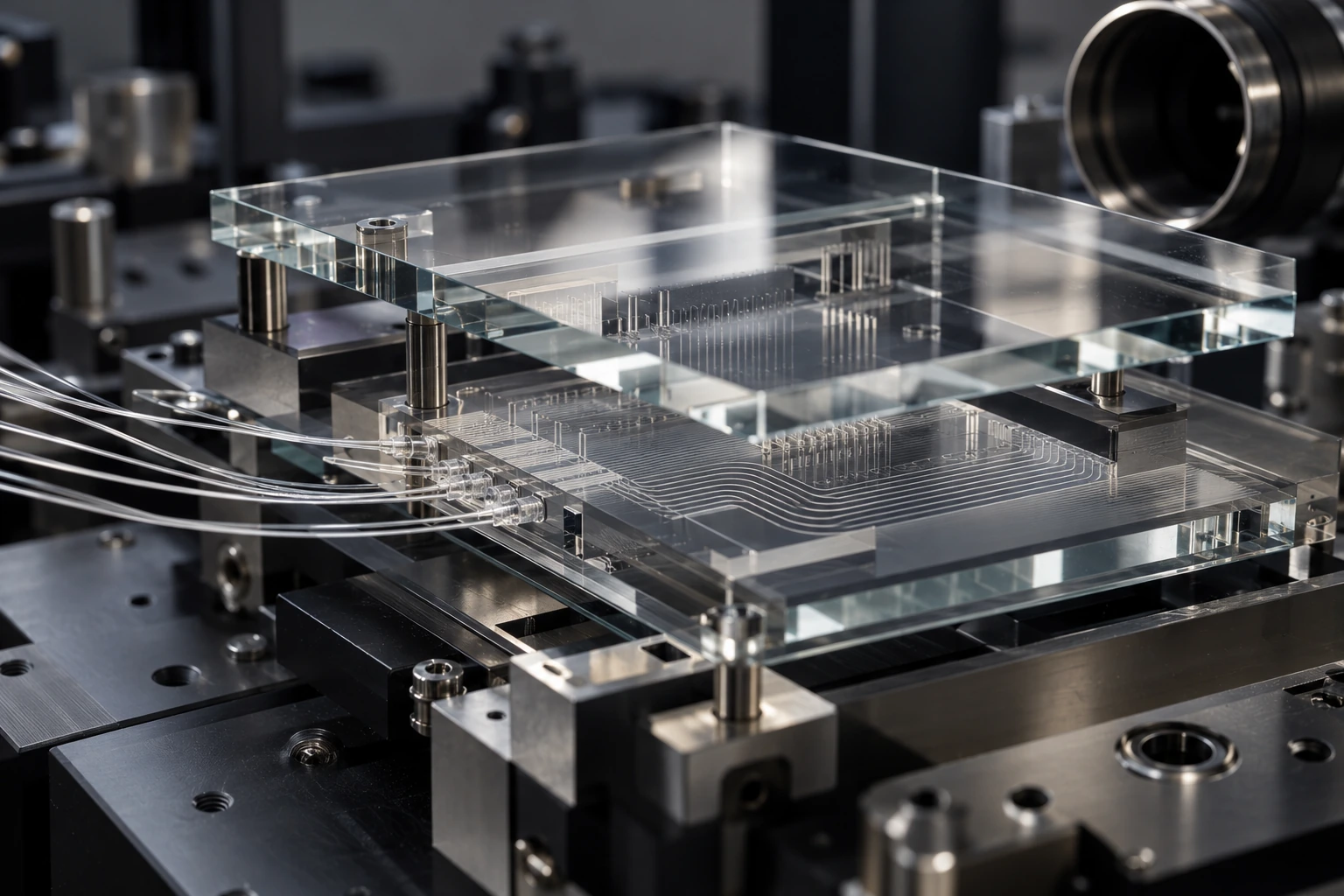
A close-up of layered glass plates and fine silicon photonic structures in a research instrument.DEEP LEARNING / COMPUTATION / SYMPLOKA
A MODEL IS BUILT FROM LEARNED PARAMETERS

The layers are mathematical transformations, not miniature minds.

Training adjusts a network to reduce a chosen error signal. The model’s job, data, and evaluation decide what that adjustment is actually teaching it.

01 / WHERE DEEP LEARNING FITS

It is one part of a much larger AI landscape.

Artificial intelligenceA broad field of approaches for systems that perform tasks such as prediction, language processing, perception, or decision support.
Machine learningA set of methods that fit models from data or feedback, rather than specifying every output with hand-written rules.
Deep learningMachine learning with models that learn through multiple composed layers of representation.
Generative AISystems designed to produce content such as text, images, audio, or code. Many current examples use deep learning, but the terms describe different things.

Deep learning is a kind of machine learning, not a synonym for all AI. Linear models, decision trees, clustering, and other approaches remain useful for many tasks. Start with the broader machine-learning guide ↗ for that comparison.

02 / WHAT THE LAYERS DO

Each layer transforms a representation of the input.

A neural network receives numbers that represent an input. Each layer applies a learned transformation and passes its result onward. With multiple layers, a model can build complex representations from earlier ones. These internal values are useful to the calculation, but they are not automatically a neat, human-readable list of concepts.

Artificial “neurons” are mathematical units that combine inputs and apply functions. The name draws a loose analogy with biology; modern neural networks are engineered systems and are generally not designed as realistic simulations of brain function.

“Deep” refers to this composition across layers. It is not a measure of consciousness, understanding, or the model’s overall quality.

03 / HOW TRAINING CHANGES A NETWORK

Compare an output with a learning objective, then adjust the weights.

  1. Prepare examples. Turn inputs—such as text, images, or measurements—into numeric representations. The training objective determines what target or signal is available.
  2. Run a forward pass. The network applies its current parameters and produces an output.
  3. Measure an error signal. A loss function scores the output against the task’s objective. The loss is a training signal, not a complete definition of what people value.
  4. Compute gradients. Backpropagation calculates how changes to parameters would affect the loss.
  5. Update the parameters. An optimizer uses those gradients to adjust the weights. The process repeats over many batches of data.

Different systems use different objectives. A classifier may learn from labeled examples; a language model may predict the next token; a diffusion model may learn to denoise. For examples of two such systems, read how language models generate text ↗ and how image generators use diffusion ↗.

04 / NOT ONE ARCHITECTURE

Different network designs suit different kinds of structure.

Convolutional networksConvolutional layers apply learned filters across local regions. They became influential for image recognition and other grid-like inputs.
TransformersAttention layers let elements in a sequence use information from other elements. Transformers are widely used for language and have also been adapted to images and other data.
Recurrent networksRecurrent designs carry a state through a sequence. They appear in sequence-processing systems, with different trade-offs from newer architectures.
Generative objectivesGenerative models learn to produce new samples. Autoregressive and diffusion models use different objectives and generation processes, and both can be built from deep networks.

These categories can overlap: a model can combine architectural ideas or use a network as one component in a larger system. For visual tasks, see the computer-vision guide ↗.

05 / WHY DEPTH IS NOT A GUARANTEE

A deeper network can still learn the wrong shortcut.

Deep models can represent complicated patterns, but their behavior depends on the data, objective, optimization, and conditions at use time. A network may overfit examples, inherit gaps in its training data, or rely on a correlation that fails in a new setting. More layers or parameters do not automatically fix any of those problems.

  1. Define the real task. Specify what a useful output means and which mistakes matter.
  2. Compare a baseline. A simpler model may be easier to train, explain, or maintain for the same job.
  3. Keep evaluation independent. Test on examples not used to fit or tune the model, and look for leakage.
  4. Measure relevant cases. Break results down by realistic inputs and users, not just one average score.
  5. Check the full product. Include prompts, retrieval, tools, human review, latency, and cost in the evaluation.

For a broader checklist, read how to interpret benchmark scores ↗ and how to choose a model for a real task ↗.

KEEP LEARNING

Go from the architecture to the working system.

Deep learning explains one way a model can be built and trained. The surrounding application still decides what data it receives, which tools it can use, and how its output is checked. Follow the AI field guide ↗ to explore the connected system.

TEXTBOOK, RESEARCH & CODEGoodfellow, Bengio & Courville, Deep Learning, Chapter 1 ↗Krizhevsky, Sutskever & Hinton, ImageNet Classification with Deep Convolutional Neural Networks (NeurIPS 2012) ↗Vaswani et al., Attention Is All You Need (2017) ↗Dosovitskiy et al., An Image Is Worth 16×16 Words (2021) ↗Computer History Museum / original AlexNet source code ↗PyTorch example models on GitHub ↗