JOURNAL / MUSIC & AUDIO GENERATION

How do AI music generators work?
From text to sound.

A music or sound generator turns a description, melody, or audio reference into a new signal. The model has to build rhythm, texture, and timing together, then keep them coherent as the sound unfolds.

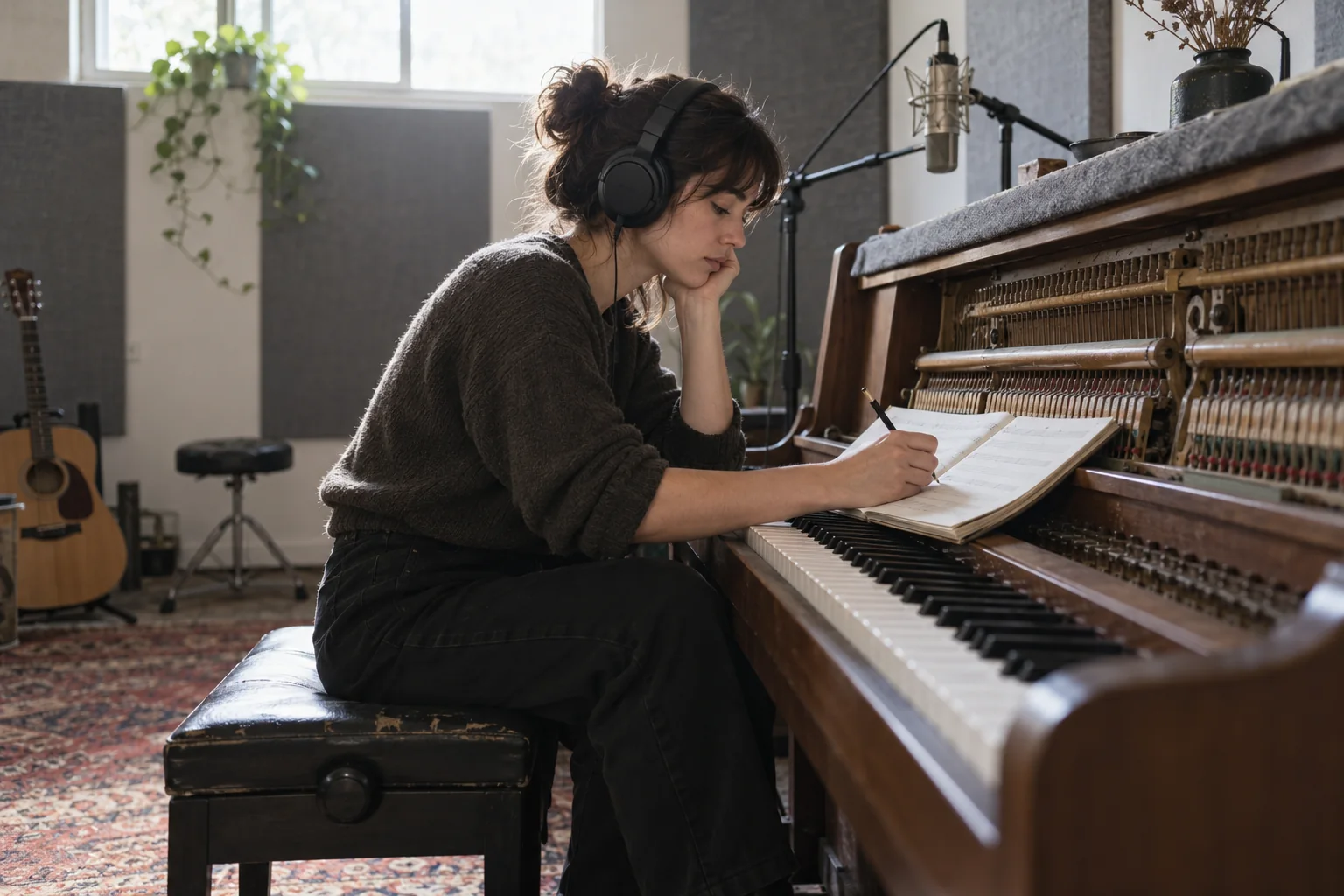
A musician listens to a melody while writing beside an upright piano in a recording studio.MUSIC GENERATION / CREATIVE PROCESS / SYMPLOKA
A DESCRIPTION BECOMES A LISTENING EXPERIENCE

A sound takes shape over time.

A useful prompt guides the direction. The model still has to compose the details that make one moment connect to the next.

01 / MUSIC, SOUND, AND SPEECH

“Generate audio” can describe several different jobs.

A text-to-music prompt might describe an acoustic piano phrase with a slow rhythm. A text-to-audio prompt might describe rain on a roof, a door closing, or a busy room. Other workflows use a melody or source recording to guide a continuation, variation, or edit. These tasks share some technology, but they need different controls and different ways to judge a result.

Speech synthesis is another kind of generation: it aims to turn words into spoken audio. A conversational voice system combines that task with recognition, dialogue, timing, and application logic. This guide focuses on music and non-speech sound, alongside those voice interfaces rather than in place of them.

02 / A COMPACT REPRESENTATION OF SOUND

A model usually works with a learned representation, not raw air pressure.

A digital recording is a long sequence of audio samples. Modeling every sample directly can be demanding, so many systems first encode audio into a more compact representation: a sequence of discrete codes, a continuous latent space, or a time-frequency representation such as a spectrogram.

During generation, the model predicts or refines that representation under conditions such as a text description, a musical idea, or an example recording. A decoder then reconstructs the waveform people hear. This representation is an internal model format; it is not a clean symbolic score where each number has a simple musical meaning.

The chosen representation affects which details are easy to model and how much information survives compression. It does not decide whether the final result follows the brief or suits the listener.

03 / TWO MODELING PATTERNS

Some predict audio tokens. Others refine noisy audio latents.

Autoregressive tokensAn encoder compresses audio into discrete codes. A sequence model predicts codes from earlier codes and conditions such as text or melody. MusicGen is a research example of a single Transformer model that generates several streams of compressed music representations.
Latent diffusionAn encoder maps audio into a continuous representation. A diffusion model learns to refine noise toward a representation shaped by its conditions. AudioLDM demonstrates this pattern for text-to-audio, with decoding steps that turn the learned representation back into sound.

These examples show different ways to build a generator, not a complete list of possible designs. “AI music” is a capability label; it does not identify one architecture or guarantee a particular sound.

04 / WHAT A PROMPT CAN GUIDE

Describe the sound, then test the parts that matter.

A useful brief can name a musical role or sound event, pace, instruments, mood, and how the result should change. Some models can also use a melody or audio reference. AudioLDM, for example, studies text-guided editing tasks such as style transfer and inpainting; MusicGen evaluates text and melody conditioning. Controls differ across systems and should be checked in the model’s own documentation.

  1. Name the source or scene. Say whether you want an instrument, a natural sound, a room ambience, or a combination.
  2. Describe how it develops. Give a pace, sequence, or change over time when structure matters.
  3. Separate essentials from mood. Identify the instrument, event, or rhythm that must be audible.
  4. Use references only when allowed. Check that you have permission to provide a melody, recording, or other source audio.
  5. Listen back to the whole output. A promising opening does not reveal whether the ending, transitions, or later bars work.

A prompt is guidance, not a score-level guarantee. If exact notes, lyrics, duration, or instrument parts matter, compare the rendered audio with those requirements instead of assuming the model followed them.

05 / EVALUATE WHAT YOU HEAR

Judge the complete signal against the intended use.

Listen on the device and in the context where the audio will be used. Review short sections and the complete piece: a loop may sound convincing in one pass but become distracting when repeated, while a long generation can change style or lose structure.

Prompt fitAre the described instruments, events, mood, and order audible?
StructureDo rhythm, melody, and sections hold together for the intended length?
Signal qualityListen for distortion, unwanted noise, abrupt edits, and artifacts on headphones and speakers.
Practical fitCheck timing, loop points, channel format, speech content, and editability for the actual project.

Automated similarity and audio-quality metrics can help compare controlled samples, but they do not replace listening for the details that matter to a particular production. Keep the prompt, model version, settings, reference files, and a human review note with important results.

06 / TRAINING, RIGHTS, AND ORIGIN

Check the specific model and source material.

Training data, licenses, and output terms vary by model. The Stable Audio Open paper, for example, describes one open-weights text-to-audio system trained on Creative Commons data. That disclosure applies to the system discussed in the paper; it says nothing by itself about another model’s training or the permitted use of a particular output.

Before using audio publicly or commercially, check the model’s data disclosures, license, service terms, and any rights in the prompt or reference recording. A generated sound is not evidence that an event or performance took place. For voice likeness, consent and the intended use deserve separate attention; see the guide to suspicious voice recordings ↗ and the guide to AI outputs and authorship ↗.

PRIMARY RESEARCHCopet et al., Simple and Controllable Music Generation (MusicGen, 2023) ↗Liu et al., AudioLDM: Text-to-Audio Generation with Latent Diffusion Models (2023) ↗Evans et al., Stable Audio Open (2024) ↗